
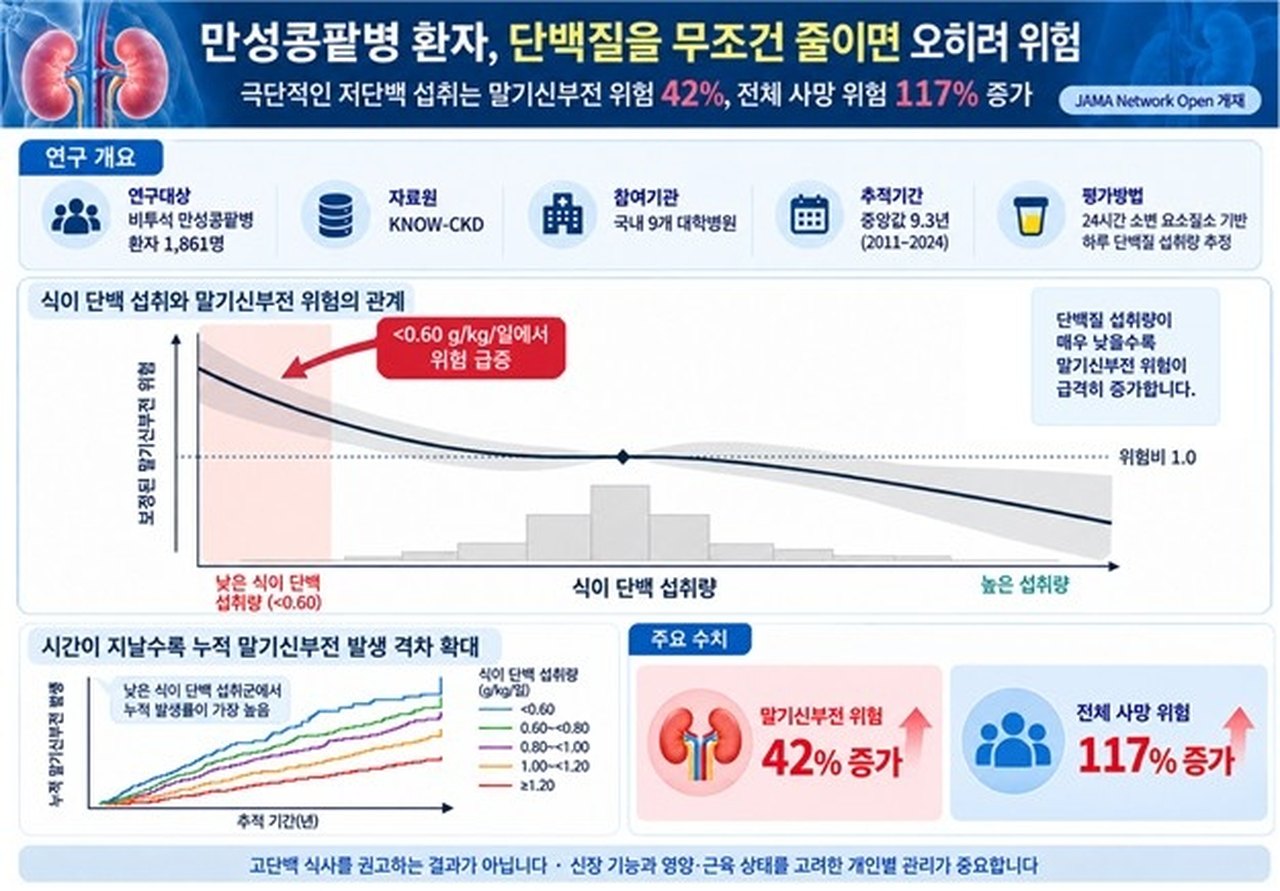
[DiaryPoint = Reporter Park Bo-young] Even with chronic kidney disease, cutting protein across the board is not necessarily the answer. On November 10, the Korea Disease Control and Prevention Agency (KDCA) highlighted a study that followed 1,861 people with chronic kidney disease who were not on dialysis. It found that the group consuming less than 0.6 g of protein per kilogram of body weight per day had higher risks of kidney failure requiring dialysis or a transplant, as well as death from any cause.
The study followed patients in South Korea for a median of 9.3 years. Compared with those consuming at least 1.2 g per kilogram daily, the group consuming less than 0.6 g had a 42% higher risk of kidney failure and a 117% higher risk of death from any cause. Because this was an observational study, it cannot establish that protein restriction directly caused the risks. Still, dietary planning should take into account that severe restriction may coincide with worsening nutritional status.
For adults not on dialysis, the suggested target is 0.8 g per kilogram a day
The 2024 KDIGO guideline for chronic kidney disease suggests that adults who are not on dialysis consume 0.8 g of protein per kilogram of body weight per day. For someone weighing 60 kg, that is about 48 g daily. This refers to the protein in food, not the food’s total weight. Eating 100 g of meat, for example, does not mean consuming 100 g of protein.
The guideline advises people at risk of kidney failure to avoid high protein intake above 1.3 g per kilogram of body weight per day. A very low-protein diet may be considered for some patients when supplemented with essential amino acids or ketoacid analogues and closely supervised by a care team. The guideline also advises against prescribing a low-protein diet to patients with metabolically unstable conditions.
Check your treatment stage before changing your diet
The study participants had not started dialysis, so its comparisons should not be used as protein targets for people receiving hemodialysis or peritoneal dialysis. Patients and family members should discuss their dialysis status, stage of kidney function, recent weight changes, food intake, and nutritional status with their care team, and ask about an individualized protein target.
The KDCA’s National Health Information Portal explains that chronic kidney disease is assessed and managed using tests including estimated glomerular filtration rate based on serum creatinine and urine tests. When estimating protein intake, distinguish the weight of a food from its actual protein content, and consider nutritional status and any other dietary restrictions. Make dietary changes in consultation with your care team and a dietitian.