
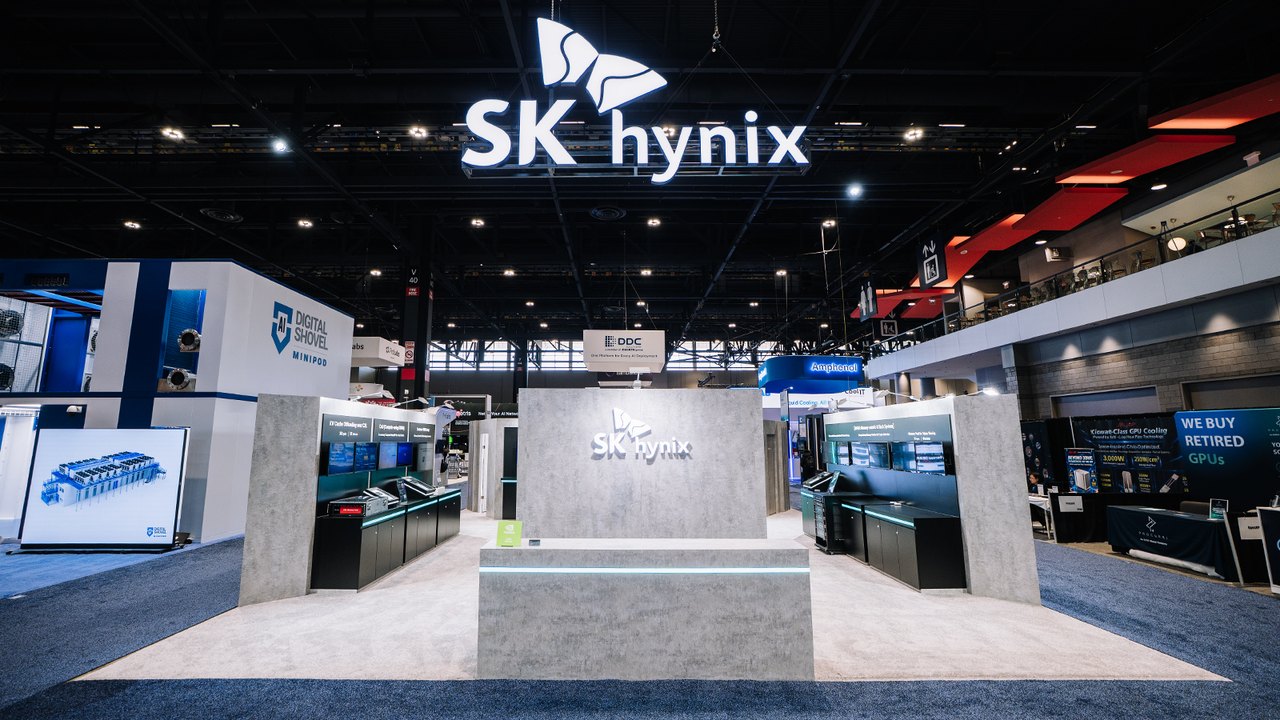
[DiaryPoint | Reporter Eom Ju-yong] SK hynix on Nov. 20 unveiled the technologies it exhibited at Supercomputing 2026 in Chicago. The company presented HBM4 and HBM4E, a CXL memory pool and MARS, a memory-centric AI rack system, outlining ways to improve how conversational AI stores and reuses data.
As AI carries on a long conversation, its “KV cache”—which holds the results of earlier computations—can grow. SK hynix demonstrated a system that keeps information likely to be needed again soon in HBM and DRAM, while storing information that may be retrieved later in a CXL memory pool. By sorting data according to where it is stored, the approach can conserve high-speed memory and let multiple servers share capacity, the company said.
MARS is a system architecture that puts memory at its center and integrates equipment from partner companies into a single server rack. In a demonstration, a CXL memory pool was used to share KV cache across servers and GPUs, as well as tokens generated by CPU servers. The approach is intended to reduce duplicate computations and cut the time GPUs spend waiting on CPU preprocessing.
The company said it had validated CXL-based KV-cache offloading with SK Telecom in a real-world large language model inference environment. Min Young-hoon, an AI systems infrastructure technology lead who presented on MARS, said that reusing cache through a CXL memory pool and sharing tokens from CPU racks can improve CPU and GPU utilization in services that handle multiple AI conversations.
Products on display included HBM4 and HBM4E alongside HBM3E, as well as a 256GB 3DS DDR5 RDIMM, a 128GB DDR5 MRDIMM, a 96GB DDR5 RDIMM and a 192GB SOCAMM2. The lineup reflected growing demand not only for high-bandwidth memory used in AI computing, but also for server main memory and storage.
The technologies are aimed primarily at AI data centers and servers. If adopted in live services, memory sharing and reuse could help reduce GPU wait times and the burden of moving data. Competition among chipmakers over memory capacity, speed and power efficiency is also expected to continue. The Supercomputing 2026 exhibition ran from Nov. 17 to 19, and the overall event wrapped up on Nov. 20.