
[DiaryPoint = Reporter Choi Seung-jin] The last supermoon of 2026 will rise on the night of November 24. In Seoul, moonrise is at 4:35 p.m., the Moon reaches full phase at 11:53 p.m., and it will appear closest to the Pleiades star cluster around 7:40 p.m.
The Moon will be easy to see with the naked eye. After sunset, look toward the Moon as it rises in the eastern sky, then shift your gaze slightly higher to find the Pleiades in the constellation Taurus. The full Moon’s bright light may obscure the cluster’s dimmer stars, so binoculars can make it easier to spot.
The best time for the Moon and cluster to appear close together is 7:40 p.m. in Seoul, 7:35 p.m. in Busan and Daegu, and 7:35 p.m. on Jeju Island. At those times, the angular distance between the Moon and Alcyone, the cluster’s brightest star, will be 0.37 degrees in Seoul, 0.40 degrees in Busan, 0.38 degrees in Daegu, and 0.40 degrees on Jeju. Calculations indicate that the objects will generally be visible from around 6:15 p.m. until about 6 a.m. the following day.
The closest approach between the Moon and the cluster, as calculated from Earth’s center, is expected around 9 p.m. Korea time on November 24. However, the distance they appear apart in the sky varies by viewing location. Around 7 p.m., both will be in the eastern sky; as the night progresses, they will move toward the south. Whether a star in the cluster passes behind the Moon—a lunar occultation—depends on the observer’s location. Local viewing guides in Korea give the times for observing the Moon’s close approach to the cluster.
The Korea Meteorological Administration forecasts that skies will generally clear nationwide after being cloudy through the early hours of November 24. Skies will remain cloudy in parts of the Chungcheong and Jeolla regions and on Jeju Island. Rain or snow may also fall from daytime in South Chungcheong, western Jeolla, and Jeju, so viewing conditions at night may vary by region.
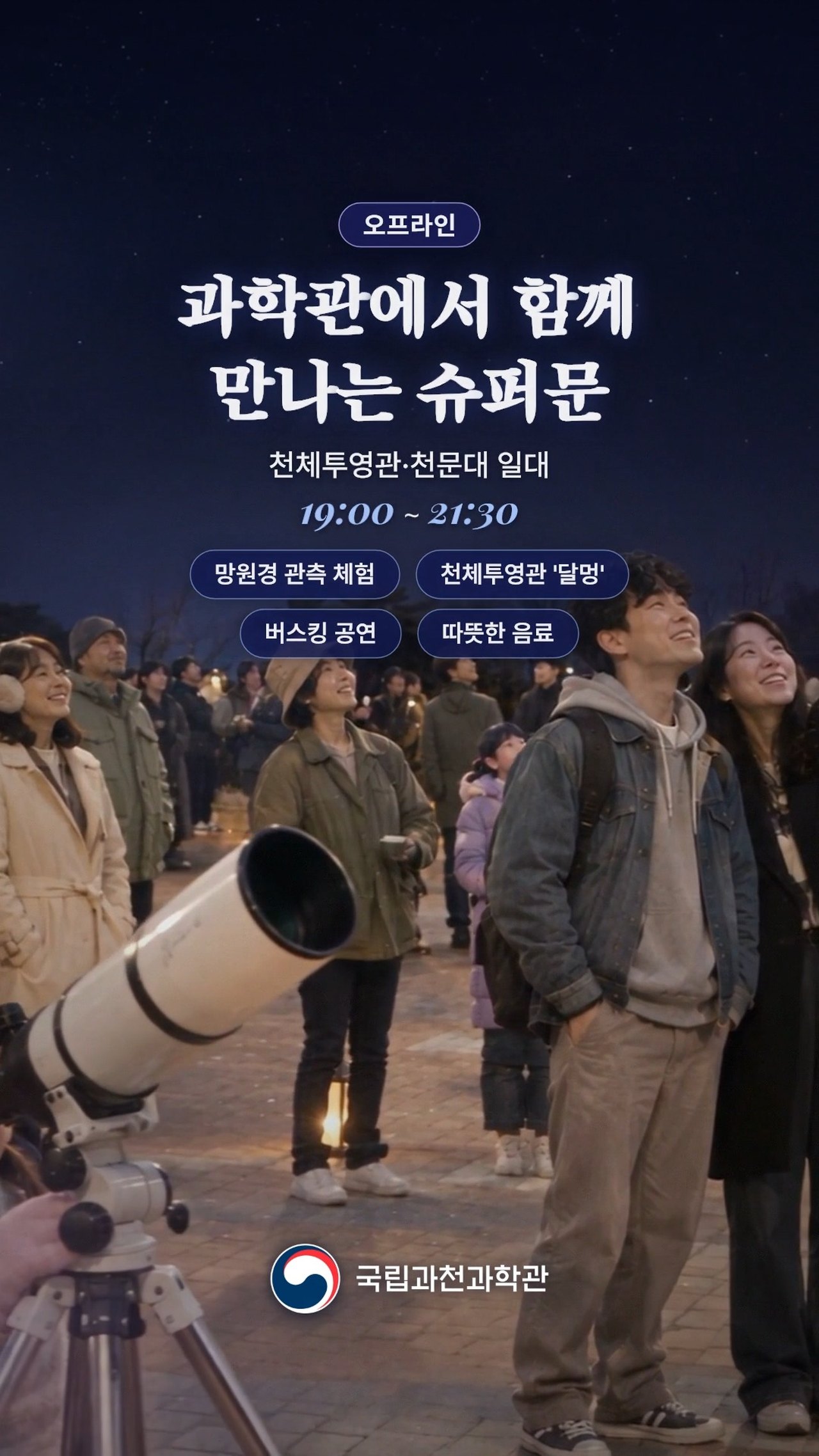
The Ministry of Science and ICT has arranged a live broadcast of the supermoon and Pleiades observation, along with an in-person viewing event, for the night of November 24. Science museums, including the National Gwacheon Science Museum, will also offer telescope viewing and planetarium programs.