
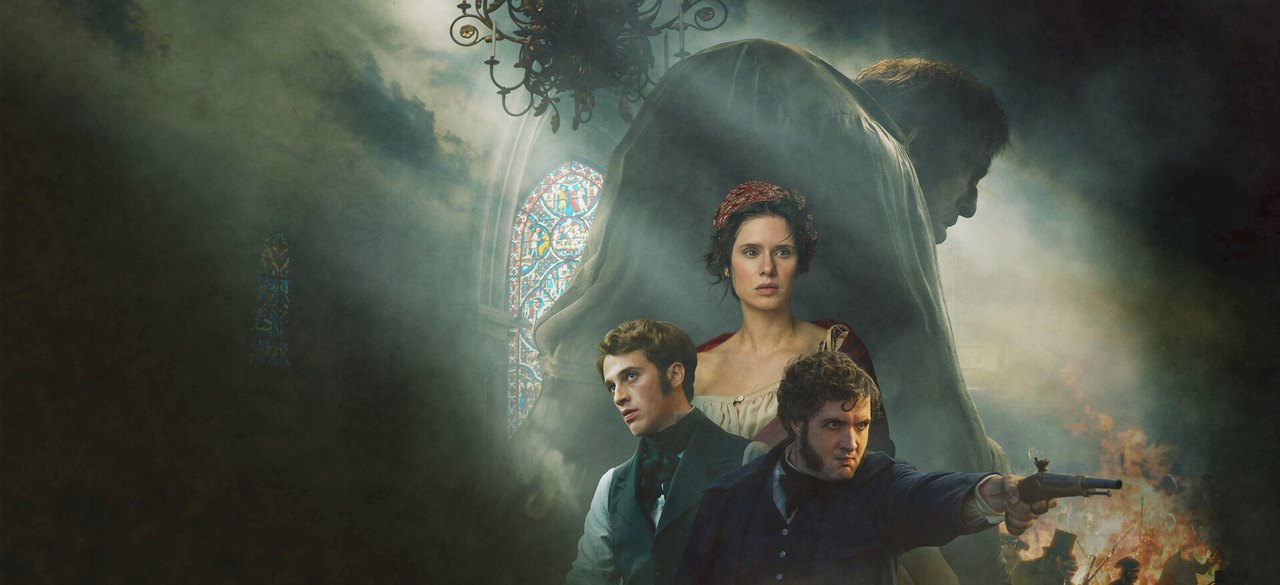
[DiaryPoint = Reporter Park Bo-young] Netflix’s film ‘Quasimodo, Soul of Paris’ premieres November 27. Vincent Cassel stars as Quasimodo, and the film will be available on Netflix. Jean-François Richet directed, with Éric Besnard and Edgar Marie writing the screenplay. According to a release schedule announced by Netflix France, the film was produced by Radar Films, with Clément Miserez and Matthieu Warter also serving as producers.
Rather than directly adapting Victor Hugo’s novel ‘The Hunchback of Notre-Dame,’ Richet’s film imagines a man in Paris in 1830 who might have become the model for Quasimodo. Instead of a medieval bell ringer, its central figure is a hunchbacked stonemason working on the restoration of Notre-Dame Cathedral. Hugo was 28 in 1830, and the film is built around the possibility that the mason’s life overlapped with the period when Hugo visited the cathedral to research his novel. Richet described it as “a story about imagining the man who may have existed before Hugo’s character.”
The film’s Paris is under the rule of Charles X, amid a cholera outbreak and on the eve of the July Revolution. Quasimodo, pursued by the police, tries to protect Agnès, the dancer he loves. The novel is set in medieval Paris in 1482. In the film, Notre-Dame appears as a ruin at risk of demolition, as it was in 1830. According to Netflix’s production notes, the cathedral had been damaged after the French Revolution, and some people considered tearing it down. Restoration began in 1845, after Prosper Mérimée was appointed inspector general of historic monuments in 1834.
Daphne Patakia plays Agnès, while Karim Leklou is Captain Coco Lacour of the guards. Benjamin Voisin appears as Gaspard Tournier de Vaillac, a doctor who conducts experiments. Noémie Lvovsky, Sébastien Pouderoux, Élie Nacmami and Alexis Rosenstiehl round out the cast. Netflix says Agnès wears red in a carnival scene, then later appears in a pale yellow dress reminiscent of Delacroix’s painting ‘Liberty Leading the People.’ Coco Lacour’s green costume references arsenic-based pigments used at the time, while the doctor Gaspard’s dark silhouette draws on the clothing of 19th-century anatomists.
Richet has explained why he conceived the film as a new story rather than a recreation of a classic. He called it “a story set in the 19th century about imagining the man who may have existed before Victor Hugo’s character.” In the director’s notes, he also recalled that after receiving the screenplay, “when I reached the final page, I thought I wanted to direct this film.” During preparation, he said, the script was revised several times to make the story darker and more physical, and to give greater weight to social and revolutionary movements.
The film’s premise grew out of a hunchbacked stonemason described in the memoirs of British sculptor Henry Sibson, who worked on the restoration of Notre-Dame. Netflix connects that account with a sketch of a hunchbacked sculptor in Hugo’s 1830 manuscript. The account was uncovered in 2010 by Adrian Glew of Tate Britain, but Richet stressed that the idea Hugo drew inspiration from the mason was “not proof.” Filming took place in France, with Bourges Cathedral standing in for Notre-Dame’s interior. At Sorbonne University, the production recreated the circular lecture hall of the Hôtel-Dieu medical school.
The production team also worked to bring the streets and interiors of Paris in 1830 to life. About 100 technicians joined the art department, and 15 sculptors created new pieces, including gargoyle statues. The costume department made 117 outfits and rented 800 more; the carnival scene alone required costumes for 300 people. For the catacomb scenes, the team made 9,000 skeletons and 8,000 skulls. Transforming Vincent Cassel took about three and a half hours of makeup each day, and the production prepared around 40 silicone masks, each used for just one day of filming.