
[Diary Point = Reporter Park Bo-young] When planning a weekend outing, many people face the same dilemma: they want to visit a famous spot, but once they get there, they end up waiting 30 minutes just to find parking, then another 30 minutes in line at the ticket counter. That's why terms like "timing battle" and "crowd-dodging game" keep popping up on Korean online communities every outing season.
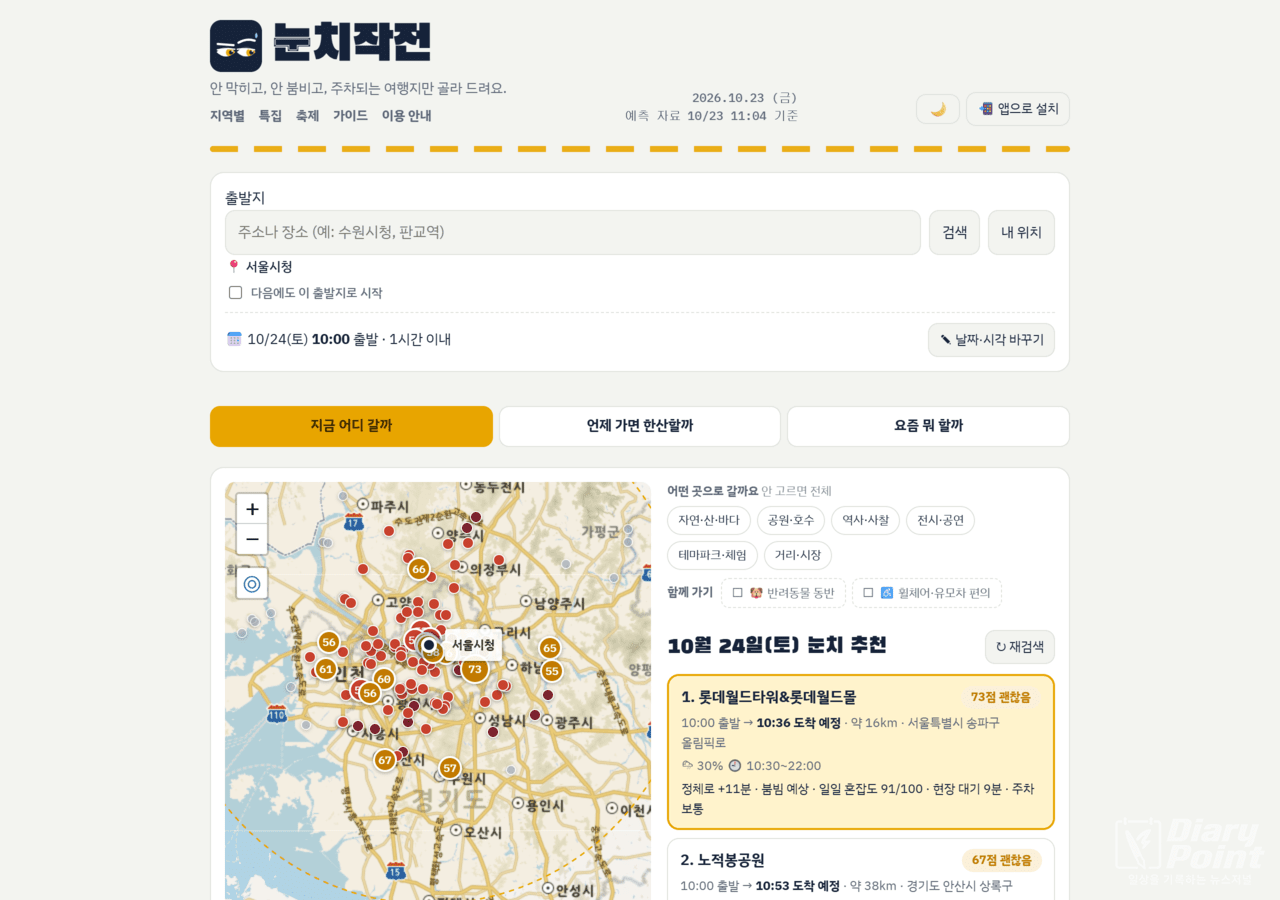
A free web service called Noonchi Jakjeon (noonchi.co.kr), which roughly translates to "crowd-dodging operation," is going viral for trying to solve this problem with data. Living up to its tagline — "We'll pick out destinations that aren't jammed, aren't crowded, and have parking available" — the site lets users enter a departure point and time, then scores and ranks nearby spots worth visiting at that exact moment.
Three tabs: Where to go now, when it'll be quiet, and what's happening these days
The homepage is split into three tabs that mirror exactly what users want to know. "Where should I go now" is the core feature: enter your departure point, date and time, and the site plots scores for nearby destinations on a map, generating a ranked list of recommendations. Users can narrow results by category (nature/mountains/sea, parks/lakes, historic sites/temples, exhibitions/performances, etc.), and there's an option to show only places that are pet-friendly or wheelchair/stroller accessible.
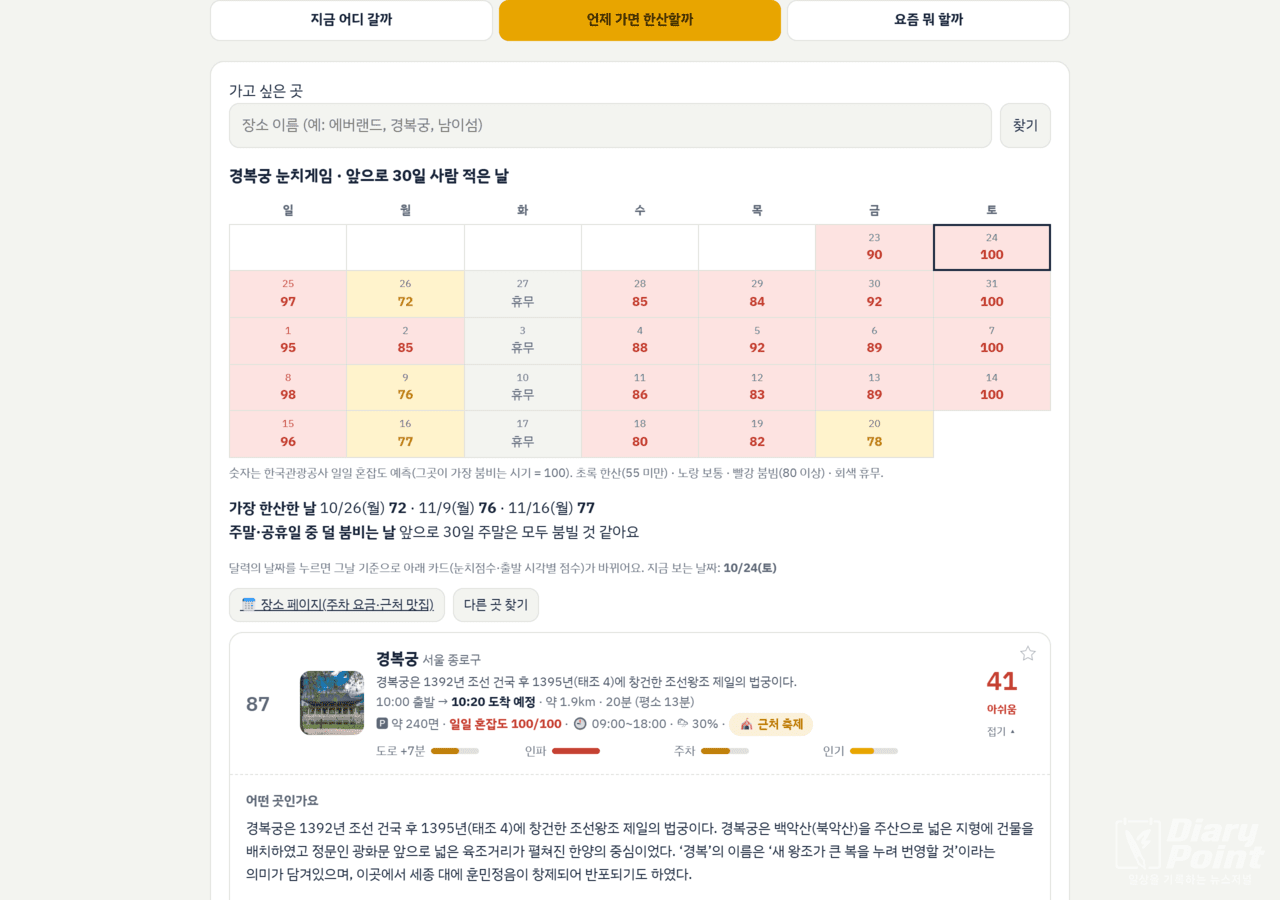
"When will it be quiet" flips the process — you pick the destination first. Search for a place you want to visit, like Everland or Gyeongbokgung Palace, and the site shows a 30-day crowd calendar along with the "least crowded day" and "least crowded weekend or holiday." Tapping a date on the calendar updates the hourly scores for that specific day.
"What's happening these days" gathers nearby festivals and exhibitions sorted by distance from your departure point, split into ongoing and upcoming events, with tags like "closing soon" or "D-5." The site also runs special features on less-crowded travel spots timed to peak seasons like fall foliage, Christmas, and the Lunar New Year or Chuseok holidays, plus a weekly roundup of quieter spots for the coming weekend.
The 'Noonchi Score' that finds famous places at their quietest
The core of the service is the "Noonchi Score," calculated by multiplying "how worth visiting is this place" by "how quiet is it right now." The quietness factor is broken into five levels based on traffic congestion, crowd density, parking difficulty and weather, then combined with how popular the destination is in its region. That means an empty but obscure location won't get recommended just because no one visits it — the system is designed specifically to catch famous places during their quiet moments.
Crowd data is based on the Korea Tourism Organization's tourist congestion forecasts (concentration rates), calculated from mobile carrier data. The figures show how crowded a location is expected to be on a given day, with 100 representing its peak crowd level. The service also draws on public data including highway traffic forecasts, Korea Meteorological Administration weather forecasts, and nationwide parking information. Locations that would be inaccessible upon arrival — due to closures or not yet being open — are automatically excluded from the rankings.
Dedicated pages for every attraction — festival schedules, and real-time crowd data for Seoul
Each of the roughly 16,000 tourist attractions and cultural facilities nationwide has its own dedicated page, featuring a 30-day crowd calendar, day-of-week averages, nearby parking rates and hours, and a curated "half-day course" pairing restaurants and cafes in the area. Pages for exhibition venues like KINTEX and COEX also display the schedule of exhibitions currently running there.
The nationwide festival schedule page separates ongoing festivals, upcoming festivals, and exhibitions into tabs that can be browsed by region or venue. Tapping a festival name brings up its dates, location, admission fees and programs, along with crowd forecasts and parking information for the nearest tourist attraction. For major spots in Seoul, the service also links to the city's real-time urban data to show how crowded a location actually is at this very moment.
Users can save a destination they want to visit, and the service will send a morning notification identifying which upcoming weekend or holiday within the next two weeks is likely to be the least crowded. No separate app installation is required — adding the site to your phone's home screen lets you use it like a native app.
The service notes throughout its interface that its figures are "forecasts, not real-time data, and may differ from actual conditions." After visiting a location, users can rate it as "quiet," "average," or "crowded," and the operators plan to compile these responses to publicly track how accurate the forecasts are. For smaller, lesser-visited attractions, the service avoids mislabeling a high congestion index as "crowded," instead showing it as "busier than usual" to prevent confusion.
Noonchi Jakjeon can be used for free on PC and mobile web browsers without requiring membership sign-up.