
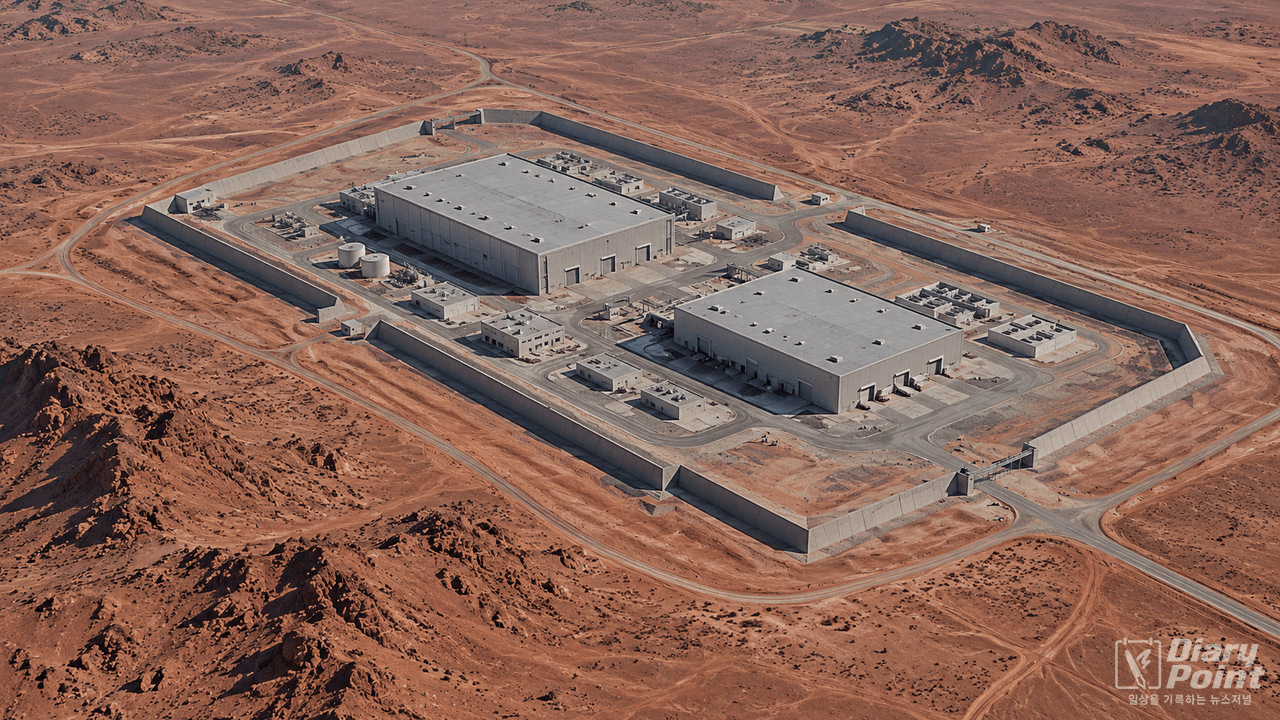
[Diary Point = Reporter Eom Ju-yong] Saudi Arabia appears to be expanding its Al Dawadmi missile production facility west of the capital Riyadh in order to manufacture ballistic missiles capable of flying farther or carrying heavier warheads, according to a new analysis. The expanded facility could be capable of starting missile production as early as the end of this year, the analysis found.
Sam Lair and Michael Duitsman, researchers at the U.S.-based Foreign Policy Research Institute (FPRI), examined commercial satellite imagery captured between April 2025 and September 2026 and identified two new buildings under construction at the Al Dawadmi missile production complex, located roughly 200 kilometers west of Riyadh.
The researchers assessed that one of the buildings houses a casting pit used to produce solid-fuel rocket motors. Protective walls were also spotted flanking the building, apparently designed to prevent any explosion from spreading to nearby structures. The other building is believed to be used for storing solid-fuel materials or finished missile components.
The new casting building is larger than the casting facility at the existing site, the analysis found, raising the possibility that it could be used to produce larger missiles or increase output of existing missile types. However, FPRI noted that satellite imagery alone cannot confirm exactly what type of missile Saudi Arabia intends to produce.
Researchers at the International Institute for Strategic Studies (IISS) and CNA, who reviewed the analysis for Reuters, also pointed to a possible link with Chinese technology based on the layout of the Al Dawadmi facility and the composition of Saudi Arabia's existing missile arsenal. Saudi Arabia is known to have acquired about 40 DF-3 ballistic missiles from China in 1987, and debris believed to be from a Chinese-designed DF-15-series missile was recently found in Yemen.
FPRI researchers raised the possibility that the new facility could be used to produce longer-range missiles such as the DF-21 or similar systems, though they stressed this remains analysis and speculation rather than confirmed fact. The Saudi embassy and intelligence agency, as well as the Chinese embassy and defense ministry, did not respond to Reuters' requests for comment.
Solid-fuel missiles can be stored for long periods and launched more quickly than liquid-fuel missiles. Analysts say that if the expanded facility does lead to a stronger missile arsenal, it could bolster Saudi Arabia's deterrence capability against Iran and its military self-reliance — but it could also intensify missile competition and proliferation concerns across the Middle East.