
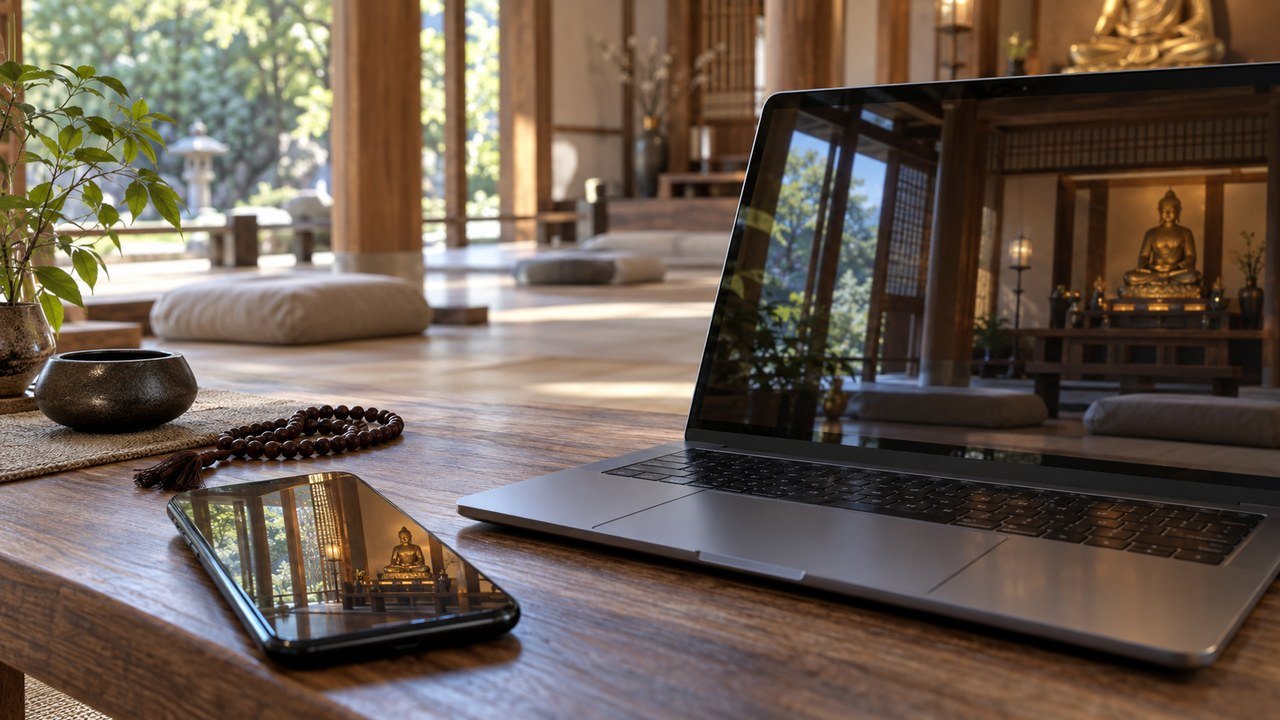
[Diary Point = Reporter Choi Seung-jin] The online temple 'Sansa' spread rapidly on social media right after its launch, logging 100,000 visitors in a single day. Accessible from a smartphone or computer, the service lets users control a child-monk avatar inside a virtual prayer hall to bow, press their palms together, or spin Buddhist prayer beads.
Sansa is a web-based space built by an independent developer known by the handle 'Metamong.' After it launched on October 29, the flood of users caused server trouble, prompting the developer to gradually expand capacity. On October 30, one server cluster called 'Cheongyeondang,' made up of 100 individual servers, was found to have 4,679 users logged in at once, with some servers reaching full capacity.
Pick a prayer hall in your browser and stay as an avatar
To use the service, visitors go to Sansa's official website and open a prayer hall directly in their browser. No separate app installation is required to explore the virtual space, and each user is automatically given a child-monk character with a randomly assigned name.
Inside the hall, users can tap on-screen buttons to press their palms together, bow, or spin prayer beads. A chanting feature lets users listen to the Heart Sutra and the sound of a wooden moktak drum, and visitors can also simply sit on a cushion without doing anything at all. Other users appear in the same space, but there is no chat or direct conversation feature.
Not a substitute for an actual temple service or worship
Sansa has not been confirmed to be a prayer hall run by an actual temple or an online dharma service operated by a religious institution. It functions more as a digital space for a brief rest, built around the movements and sounds of virtual characters. For that reason, bowing on screen cannot reasonably be considered equivalent to visiting a real temple, consulting with a monk, attending a dharma service, or taking part in religious activities such as prayer or offerings.
Part of what made it go viral is a structure that demands no religious obligation or conversation. Users can log on briefly before work or during a lunch break and simply linger in the virtual space, gaining a sense of togetherness without having to talk to anyone else. Many users have reported feeling calmer after using the service, but that should be understood as a personal, subjective experience.
Check the official address before entering personal information or payment details
As of this writing, the homepage of Sansa's official website contains no login or payment prompts, describing itself only as a space to rest while spinning prayer beads and bowing. If any link claiming to be related to Sansa asks for a resident registration number, bank account number, card details or a verification code, users should first confirm whether it is the genuine official address.
Rather than clicking shortened links found in search results or social media posts, it is safer to type the official domain, 'sansatemple.com,' directly into the browser's address bar. If separate pages appear offering paid prayers, merit-point accumulation or donations, users should avoid making any payment until they have verified the operator's identity, refund policy and privacy policy. As Sansa's user numbers have surged, server stabilization work and new features are reportedly still underway, meaning its operating method and privacy notices could change going forward.