
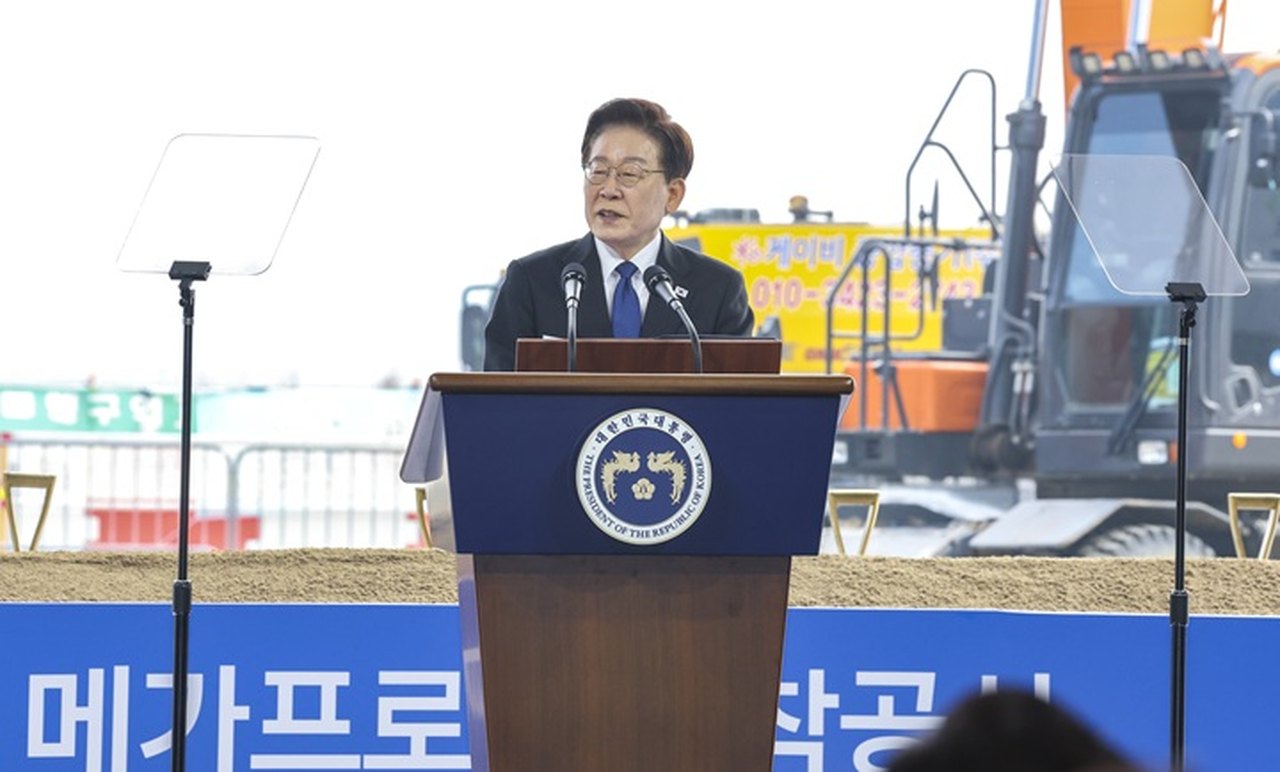
[Diary Point | Reporter Kim Jung-hoon] Four months after the Chungcheong region’s megaprojects were announced, construction began on the first projects on the 12th. They include a 6 trillion won high-bandwidth memory (HBM) packaging fab at Samsung Electronics’ Onyang Campus in Asan, a semiconductor package substrate production line by Samsung Electro-Mechanics in Sejong, and an IT display production line by Samsung Display in Cheonan and Asan.
Samsung Electro-Mechanics plans to invest 8 trillion won to expand production of advanced substrates for GPUs and CPUs at the Myeonghak Industrial Complex in Sejong. Samsung Display will invest 67 trillion won to expand production capacity for its 8.6-generation IT display line. Further investment in advanced equipment is also planned at the Onyang Campus, separate from the packaging fab.
The Chungcheong megaprojects had 392 trillion won in investment plans already on the books. Another 112 companies in sectors including semiconductors and biopharmaceuticals have since drawn up plans for an additional 23.6 trillion won. By sector, 40 AI and machinery companies plan to invest 11.9 trillion won, 17 biopharmaceutical companies 5.9 trillion won, and 17 semiconductor companies 2.4 trillion won.
Mid-sized and small businesses account for 16.5 trillion won of the additional plans, across 100 companies. The government will support permits, subsidies and tax credits to help materials, parts and equipment suppliers join the supply chains of major anchor companies. It will also provide 48.7 billion won through 2028 for 17 joint research and development projects with those companies. The government said it would work to ensure that the investment plans translate into actual supplier relationships and business opportunities.
On workforce development, the plan calls for training 10,000 skilled and hands-on workers for advanced industries in the Chungcheong region each year. Training will draw on university programs, sector-specific academies, boot camps and Meister high schools, which offer specialized vocational education. The government also plans to invest 1.5 trillion won by 2030 to upgrade existing industrial complexes with a focus on young workers and advanced industries.
Reliable power and water supplies, aligned with the investment schedule, were also identified as priorities. The government will develop measures to ensure stable electricity supplies and build new water treatment plants, among other steps. It plans to invest 1.9 trillion won in infrastructure for advanced industries in the region by 2030. At a review meeting, President Lee Jae-myung said, “What matters now is action, not words,” and called for projects to break ground on schedule and for support for local small businesses and startups.
Of the 10 projects being pursued by eight anchor companies, the government has set a goal of starting construction on six by the end of this year. For the remaining four, it aims to begin two in 2027 and two in 2028–2029, while continuing to support permitting and infrastructure.