
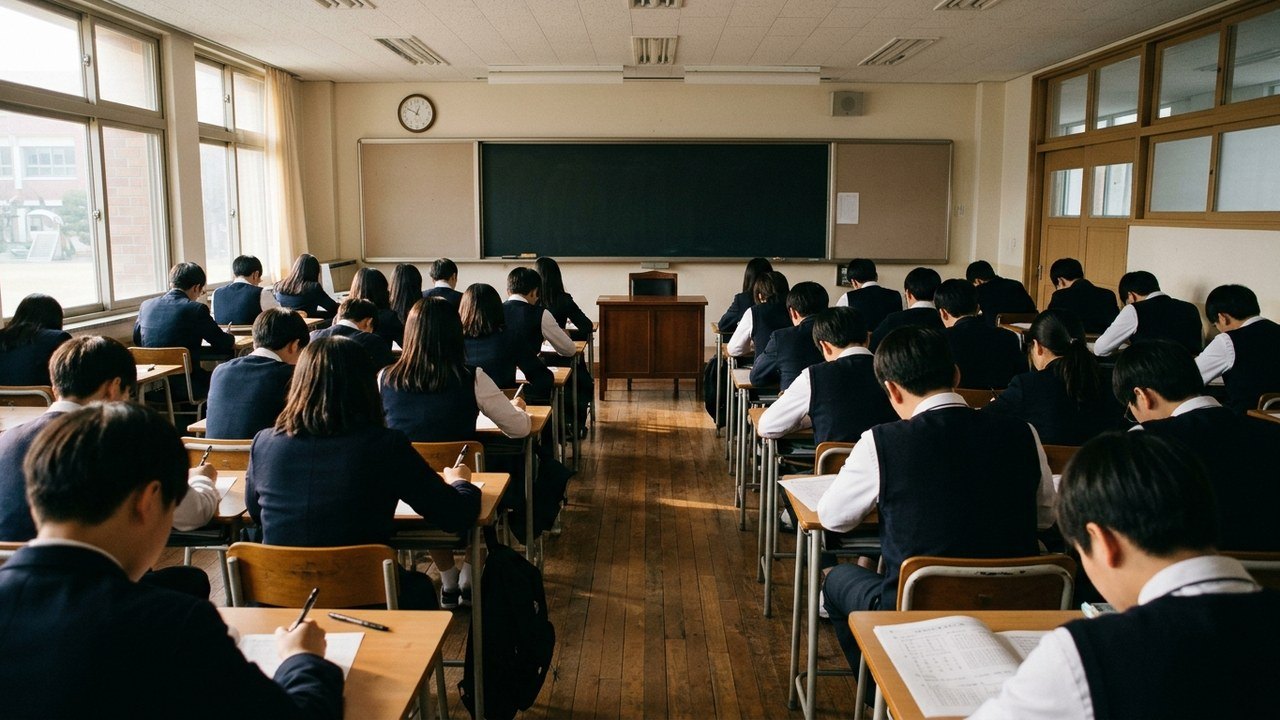
[DiaryPoint Reporter Park Bo-young] As concerns grow about cheating with artificial intelligence (AI) and advanced electronic devices, Jemulpo High School in Incheon is continuing a tradition that began in 1956: holding regular exams without teachers supervising in the classroom. Even with public attention focused on exam fairness ahead of the 2027 College Scholastic Ability Test, the school has kept student autonomy and trust at the heart of its educational principles.
At Jemulpo High, proctor-free exams begin with a pledge five minutes before the first period during exam week. Students raise their right hands together and declare, “Proctor-free exams are our school’s pride,” then chant, “One point earned with a clear conscience is more honorable than 100 points earned by cheating.” After the chant, a teacher enters to distribute the test papers and answer sheets.
As soon as the teacher confirms that the papers have been distributed properly, they leave the classroom. No proctors remain in the room during the exam; the teacher returns 10 minutes before the end to collect answer sheets. After the exam, every student submits an anonymous survey called “Voice of Conscience,” noting anything unusual during the test or reflecting on their own experience.
At the first exam in 1956, 53 failed—and were praised for their integrity
The policy was introduced for midterms in the first semester of 1956 by the late Gil Yeong-hui, Jemulpo High’s founding principal. The school had opened in 1954, and Gil established its motto: “Learning is the lamp of society; conscience is the salt of the nation.” At the first proctor-free exam, 53 of the school’s 569 students scored 60 or below and failed. Gil encouraged them, saying they had resisted the temptation to cheat and protected their conscience by taking the test honestly. All of those students advanced to the next grade the following semester.
As smartphones, smartwatches and other advanced information technology (IT) devices became commonplace, the school strengthened measures to keep them out of exam rooms and prevent opportunities for cheating. Despite concerns that digital devices have made cheating methods more sophisticated, the school has maintained its principle of preventing access in advance and trusting students, rather than expanding surveillance. A Jemulpo High representative said, “Even if technological progress brings more temptations, restoring surveillance because we distrust students runs counter to the essence of education. We will continue this honorable tradition, grounded in conscience.”
Education offices across South Korea and the Korea Institute for Curriculum and Evaluation will administer the 2027 College Scholastic Ability Test at exam sites nationwide on November 19. Strict anti-cheating controls, including proctor entry and metal detectors, will be in place on test day. Meanwhile, the proctor-free exams built around conscience and trust in public schools over the past 70 years are seen as a reminder of the value of educational trust.