
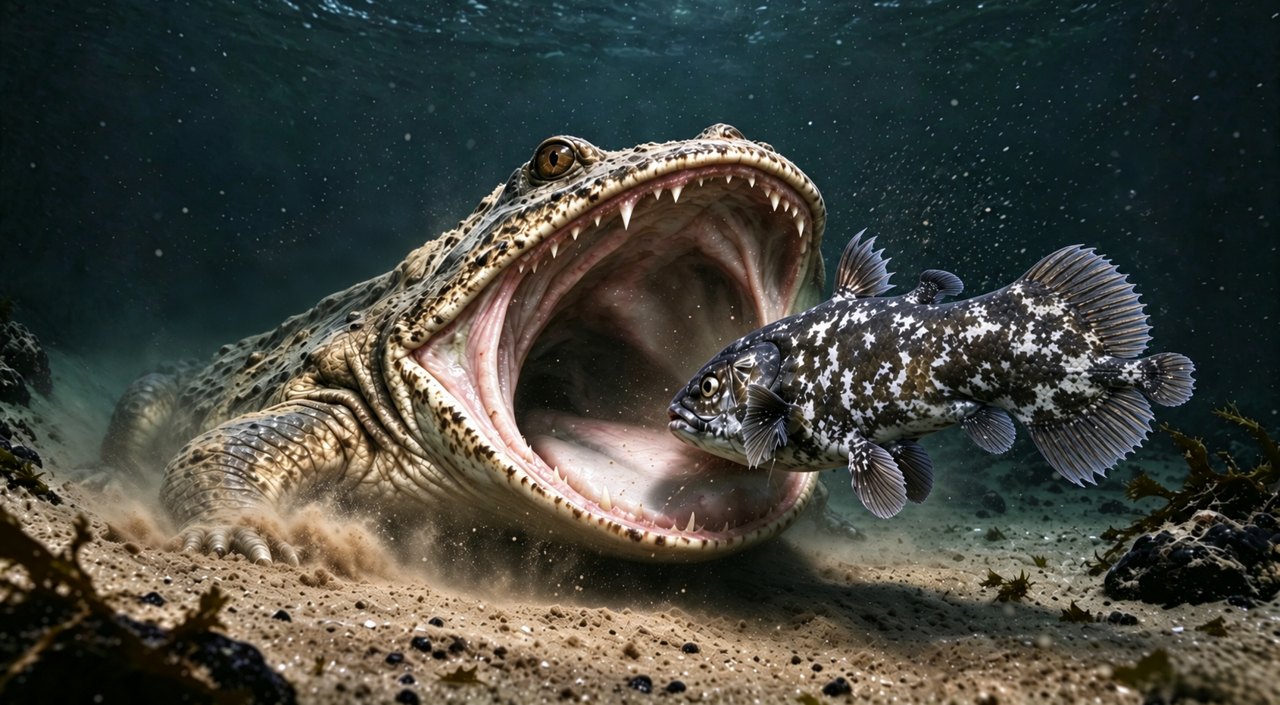
[DiaryPoint] When people picture a frog or salamander, they usually imagine a creature moving between water and land. But around 237 million years ago, there was an amphibian that never left the sea at all. The discovery of two nearly complete skeletons in Guizhou Province, China, has provided the strongest fossil evidence yet of an amphibian lineage that made the ocean its permanent home.
In a study published in the journal Nature Ecology & Evolution, researchers named the animal a new species, Gerrothorax maritimus — literally "Gerrothorax of the sea." The preserved skeletons measured 73.7 cm and 48.7 cm respectively, with the body and limb bones remaining largely intact and in their original positions.
Why Scientists Believe It Lived Only in the Ocean
The fossils were found in what was, during the Late Triassic, a marine environment at least 30 km from the nearest shoreline. If the carcass had simply drifted out from land, it likely would have decomposed or lost its limbs along the way. Instead, this specimen remained connected down to the finger bones. Strontium isotope ratios preserved in the bones also closely matched the signature of ancient seawater, leading researchers to conclude the animal most likely grew up and lived its entire life in the ocean.
This discovery matters because it marks the first confirmed case of a fully marine amphibian, whether among living species or in the fossil record. The skin of modern amphibians is highly permeable to water and gases, which works well on land or in fresh water but can cause dangerous water loss and salt imbalance in seawater. While some amphibians can briefly tolerate saltwater, none have been known to make the ocean a permanent habitat — until now.
How It Differed From Today's Frogs
G. maritimus was not an ancestor of frogs, nor the same kind of animal as modern frogs. It belonged to a distant branch of the amphibian family tree known as stem amphibians. Its body was flat, with wide areas of the back and belly covered in bony armor. Researchers believe this armor reduced the exchange of water and salt through the skin, easing the water-loss problem that seawater would otherwise cause.
With the skin playing a smaller role, the gills and digestive tract may have taken on greater importance for breathing and salt regulation. One hypothesis is that the animal drank seawater, absorbed it through the digestive tract, and expelled excess salt through its gills. Since this physiological process cannot be directly observed in a fossil, it remains an evolutionary inference based on skeletal structure rather than a confirmed fact.
The armor may have offered other advantages as well. Its weight could have acted like ballast, helping the animal stay anchored to the seafloor, while its flattened body shape would have made it easier to hide in sediment. The large mouth and throat structure suggest it may have fed by suddenly sucking in prey along with water when potential meals came close — a hunting style similar to that of modern wobbegong sharks, which lie camouflaged on the seabed waiting to ambush prey.
The key takeaway from this research is that evolution does not always require building entirely new organs from scratch. Bony armor and gills that the animal already possessed may have become stepping stones for adapting to seawater rather than liabilities, once the environment changed. Viewed through the long history of marine life, the discovery suggests that the long-standing assumption that amphibians simply "cannot live in the ocean" had at least one striking exception — a finding that is likely to broaden how scientists interpret other marine fossils going forward.