
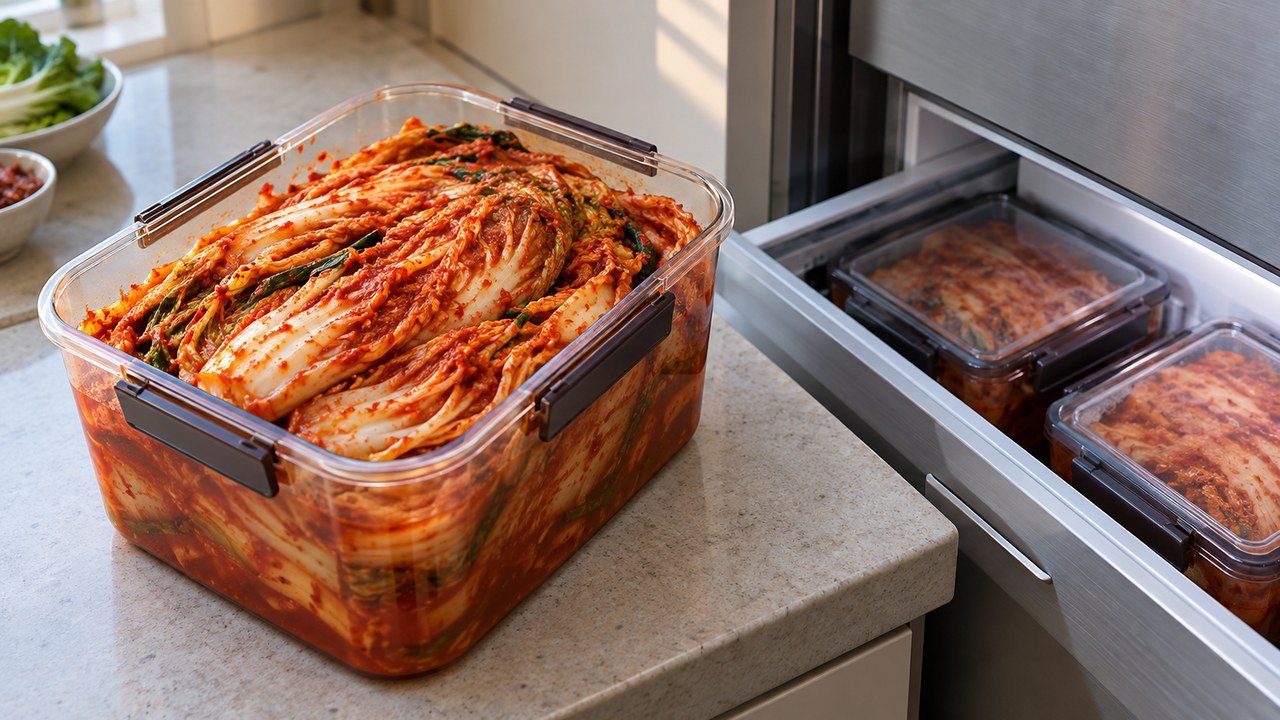
[DiaryPoint = Reporter Choi Seung-jin] For kimjang kimchi—the large batch of kimchi traditionally made in Korea for winter—it is generally better to put it in a kimchi refrigerator soon after making it than to let it ferment at room temperature first. Kimchi continues to ferment slowly even at low temperatures, so the longer it sits out, the faster it ripens. Fermentation continues after it goes into the kimchi refrigerator, too.
How quickly kimchi ripens, and how much its temperature fluctuates, are key to how it tastes. Korea’s Food Safety Korea advises refrigerating foods that require cold storage as soon as you bring them home and keeping them sealed in a container. The same basic approach applies to kimchi: minimize the time it spends at room temperature and store it in a dedicated space where the temperature stays relatively steady.
Use the kimchi storage setting for freshly made napa cabbage kimchi
For standard napa cabbage kimchi and kkakdugi, a type of cubed radish kimchi, pack the kimchi tightly in its container with little empty space and press it down so it is covered by its brine. Then use the kimchi refrigerator’s standard storage setting. Some LG Electronics kimchi refrigerator manuals recommend putting kimchi in the appliance right after making it and using the “Medium” kimchi storage setting as the default for long-term storage. The manuals list a storage temperature of about -2 to -1°C.
Samsung Electronics lists about -1.3°C for its standard setting for regular kimchi. Depending on the model, users can adjust the temperature with Strong Cold, Standard, or Mild Cold settings. The temperature and operation can vary by model, however, so check the settings in your appliance’s manual rather than relying on the mode name alone.
Use a ripening mode only when you want the kimchi to ferment further
If you want to mellow the fresh, grassy taste of new kimchi and bring out a tangier flavor sooner, you can use a ripening mode offered by the manufacturer. Some Samsung models have a function that ripens kimchi at room temperature before automatically switching to standard storage. Others offer different ripening times for varieties such as kkakdugi and dongchimi, a watery radish kimchi. If your appliance has no ripening function, it is safer to avoid leaving kimchi out for a long time; instead, take out a small portion to taste and adjust how you store the rest.
Kimchi that is already well fermented should stay in a storage mode, not a ripening mode. Keeping it in a warmer compartment or one that is opened frequently can make it sour and soft more quickly. If you want to slow fermentation without freezing the kimchi, consider a lower-temperature setting such as Strong Cold or Crisp, available on some Samsung models. If you see ice crystals forming, switch to Mild Cold.
Check for a dedicated setting for low-sodium and watery kimchi
Low-sodium kimchi may freeze more easily than regular kimchi because it contains less salt. Samsung’s guidance gives low-sodium kimchi a different temperature range from regular kimchi, and its Mild Cold setting can reach around 0°C. For watery or low-sodium varieties such as baek-kimchi, a white, chili-free kimchi, and dongchimi, check whether your appliance has a dedicated low-sodium or dongchimi setting. If not, first look for a gentler cooling setting recommended in the manual.
Follow the appliance’s instructions for using kimchi containers, which are designed to let gas produced during fermentation escape. Avoid storing kimchi sealed only in a plastic bag. Keeping the kimchi submerged in brine and minimizing the air at the surface can help slow changes in color and texture. Do not pack the refrigerator too tightly, as that can restrict airflow. Leave some room between containers and avoid opening the door often.
If kimchi develops an unusual odor or mold on the surface, throw it away rather than tasting it to decide whether it is safe. Food safety authorities advise against eating moldy food because toxins can remain even after heating. If kimchi keeps turning soft or souring too quickly, check not only the storage temperature but also the salt level, seasoning, container seal, and the appliance’s operating settings.