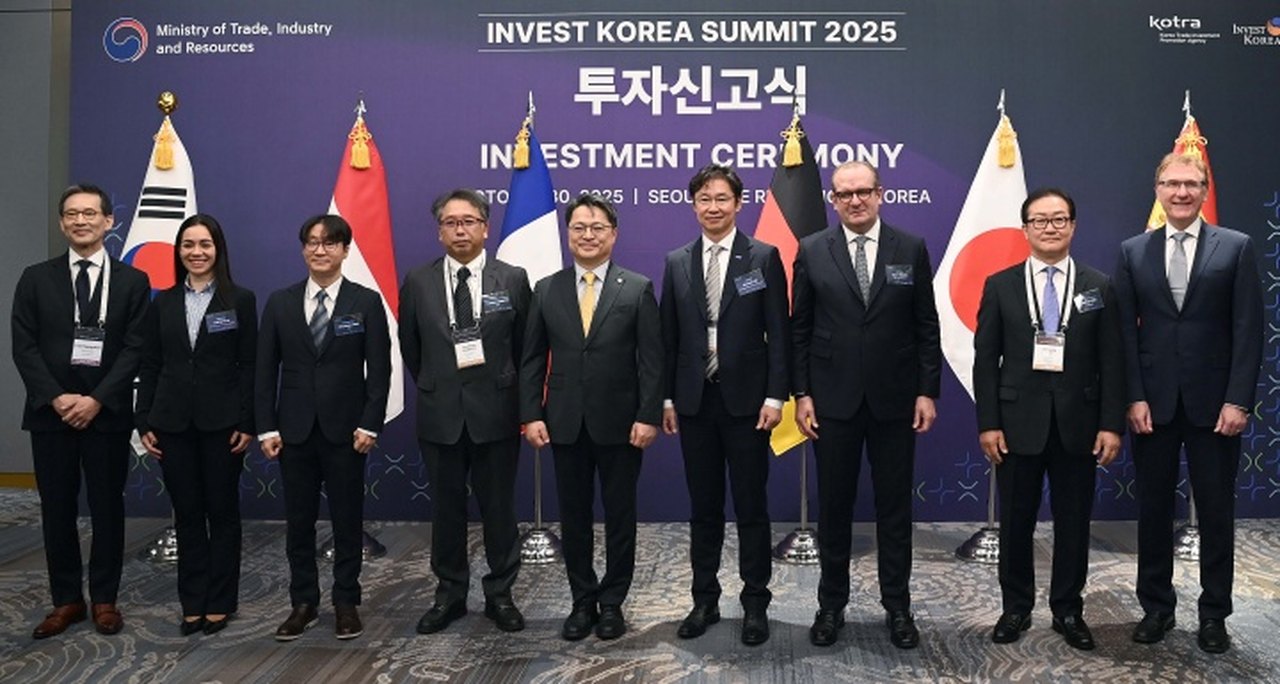
[Diary Point = Reporter Kim Jeong-hun] Seven global companies reported $2 billion in planned investment in South Korea at the Invest Korea Summit, which opened Nov. 4. It was the largest total ever announced at the event. The figure reflects reported investment commitments; it does not mean that the money has already entered the country or been fully spent.
According to the Ministry of Trade, Industry and Energy, $1.97 billion, or 97% of the reported total, is for investment outside the capital region. The plans span AI data centers, semiconductors, advanced materials, and renewable energy, including solar and wind power. Such projects could bring facilities, suppliers and research hubs to regional areas, but the announcement does not specify when construction will begin or when the investments will be carried out.
Semiconductors, AI infrastructure and energy lead the plans
The companies are the United Kingdom’s Nscale, France’s Air Liquide, U.S.-based Amkor Technology, Singapore’s Gurīn Energy, Norway’s Deep Wind Offshore, Japan’s Tokyo Electron and Germany’s Henkel. Their projects cover AI data centers, semiconductor manufacturing and back-end processing, semiconductor materials and industrial gases, and solar and wind power. Together, the commitments target both the data-center power needs of expanding AI use and the semiconductor supply chain.
The ministry also said it would newly designate research and development centers for foreign-invested companies Edwards of the United Kingdom, Valeo of France and Ibiden of Japan. The centers focus on vacuum pumps for semiconductors, autonomous-driving components and semiconductor graphite, respectively, and all are located outside the capital region. The ministry also outlined eased permanent-residency requirements tied to the designations and bonus points for participation in R&D programs reserved for foreign-invested companies.
Investment figures alone do not show the jobs impact
The effects on South Korea’s industries and employment will depend on whether the plans turn into operating sites and hiring. The ministry’s materials mention additional research staff at Henkel, but provide no overall estimate for new jobs or hiring timelines across the investments. That makes it difficult to translate the reported investment total directly into a job count.
The summit runs in Seoul through Nov. 6. On the final day, participants are scheduled to visit industrial sites in four regions: Gwangju and South Jeolla, Busan, Daegu and North Gyeongsang, and Gyeonggi. Further details on investment execution, regional project schedules and actual hiring plans will be needed to assess how the commitments may affect local jobs and industrial bases.